Monday, 7 March 2011

Book Review: Treachery in Death

treachery in deathTreachery in Death by J.D. Robb

Publisher: Little Brown Book Group

Category: Crime fiction

Challenges: Mystery and Suspense Challenge

Synopsis: Detective Peabody accidentally overhears two dirty cops discuss the death of a weasel. Lieutenant Eve Dallas and her team have to bring justice and clean up the police.

My Thoughts: This was a solid addition to this series. It didn’t blow me away but it also didn’t bore me to death.

The book deals very well with the emotions one feels when someone or something you trust in breaks that trust. However, this is dealt with primarily through secondary characters such as Dr Mira. This makes this a little…I don’t know…thrown to the side?

I’m finding it hard to write about this instalment because it follows the pattern of all the other books in the series. A crime is committed and Eve and her team solve it. There is more to it of course but even the tension between Eve and Roark because she does something dangerous feels…done…

The one thing that is a bit different is Eve’s reaction to Bella, Mavis daughter. She isn’t quite as afraid as she normally is. But even that doesn’t seem so strange any more. Eve has grown a great deal in the series and as much as I love the characters and the world it feels like it might be time to wrap this one up. Don’t really know what else to say about the book. It has all been done. And I hate to say it.

Signature_thumb[1]_thumb

Copyright ©2011 Zee from Notes from the North. This post was originally posted by Zee from Notes from the North. It should not be reproduced without express written permission.

Friday, 4 March 2011

Book Review: Rilla of Ingleside

Rilla of InglesideRilla of Ingleside by L.M. Montgomery

Publisher: Bantam Books

Category: Classic

Synopsis: The spectre of the first world war that we saw in Rainbow Valley comes to fruition and the boys of Glen St. Mary go off to war. Left at home is young Rilla and the rest of the women. What follows is four years of joys and sorrows and growing.

My Thoughts: It is possible that this is my favourite book in the Anne series. Anne was more of a heroine for me growing up but this book really captured me in my early teens. I have no idea how many times I read it between the ages of 14-18 but to say that I read it at least twice a year is no understatement. I should add that at the same time I had a bit of a thing for war stories in general.

What I find particularly good about this book is the fact that it shows the home front during the first world war, something I have found relatively little written about. A lot of the focus is usually on the second world war. I also appreciate that the book is about Canada and not one of the usual suspects when it comes to war narratives.

This book has me in floods of tears at times and has the romantic in me going all gooey at other times. Montgomery has somehow managed to balance the lovely with the sad to a perfect mix. And I still love it as much now when I am an adult as I did as a teenager. Strangely enough I can still identify with Rilla as much now as I did then. Although I now lament the fact that we do not get as much Anne as I would have liked. It is fantastic to get a teenaged girls point of view on the events of the war that was to be the war to end all wars, but I would also have liked the views of the mother.

Like the other Anne books this book is told in an episodic fashion but because of the war there is more of cohesive theme and a feeling for time. It isn’t quite as jumpy and not all the stories are events. The narrator also switches at times. Mostly it is an omniscient narrator but occasionally it is Rilla who tells the story, primarily through her diary entries. The switching is never a problem but rather it feels very organic. 

My love for this book has put me in a bit of a predicament. The ending is somehow both satisfying and unsatisfying. I’ve always wished that there was one more book so that I could find out what happens to, primarily, Rilla. Now I’ve found out that there is another volume that at least could answer some questions. You’d think I would pounce on it. But part of me is scared that it won’t end the way I want it to. I’ve had my mouse hovering over the click to buy button several times. I’m just scared. Should I buy it? Has anyone read The Blythes Are Quoted? Will it make me happy?

Signature_thumb[1]

Copyright ©2011 Zee from Notes from the North. This post was originally posted by Zee from Notes from the North. It should not be reproduced without express written permission.

Wednesday, 2 March 2011

Book Review: Rainbow Valley

Rainbow valleyRainbow Valley by L.M. Montgomery

Publisher: Bantam Books

Category: Classic

Synopsis: Anne is grown up and the focus of this book is on her children and their friends. The Blythe children love playing in the little valley below Ingleside which they have named Rainbow Valley.

My Thoughts: This Anne book has never been one of  my favourites. I think part of it is that there is no central character. Sometimes this can be an advantage as it can appeal to many different readers. You can connect with the one that best´suits you. But unfortunately I think that in this case we don’t really get to know any character well enough to connect with them. It is just a little bit to fractured.

One could say that the book focuses on the Meredith children. Mr Meredith is the Presbyterian minister in Glen St Mary where Anne and her family live. Mr Meredith is a widower with four children whom he loves but as he is somewhat spacy to a certain extent neglects. However the book also features the orphan Mary Vance, Walter and Jem Blythe and on one occasion Rilla Blythe. All of these are likeable characters (although Mary Vance drives me insane) but there just isn’t enough of one of them to really drive the story.

Like Anne’s House of Dreams the story is told in somewhat of an episodic fashion. This means that you have little sense of how much time passes between different episodes and I think this in combination with the many characters adds to my confusion.

At the same time this is a sweet story about being children in a, in some respects, less complicated time. The Merediths, the Blythes and Mary Vance play in Rainbow Valley and the Methodist graveyard and other places around Glen St Mary without much interference from the adult world. The benign neglect offered by the adults lead to an imaginary world that for the most part is lovely but on occasion scary.

This is a sweet book but not an essential read in the Anne universe (although an event in this book is referenced in Rilla of Ingleside). Despite this the book has one of my favourite endings of all time. The foreshadowing of the events in Rilla of Ingleside always takes my breath away. It is foreshadowing at its best at the same time as it shows the heartache and longing of whole generations.

CymLowell

Signature

Copyright ©2011 Zee from Notes from the North. This post was originally posted by Zee from Notes from the North. It should not be reproduced without express written permission.

Monday, 28 February 2011

Book Review: Underbara dagar framför oss

Underbara dagar framför ossUnderbara dagar framför oss (Wonderful Days Ahead of Us) by Henrik Berggren

Publisher: Norstedts förlag

Category: Biography

Challenges: Nordic Challenge, Memorable Memoirs

My Thoughts: 25 years ago today then Swedish Prime Minister Olof Palme was walking home from the movies with his wife. As they walked a man came up and shot Palme and injured his wife. Christer Petterson was convicted of the murder but on appeal was acquitted. No one else has ever been tried for the murder. Palme has acquired somewhat of a mythical reputation in Sweden.

The murder of Olof Palme is my first political memory. I wasn’t quite five yet. My abiding memory of this time is that I thought he had a funny name (Palme sounds like palm tree in Swedish) and that his successor was nicknamed The Shoe (he had a very long face) and that all the adults went around looking serious.

I wanted to love this book. And at times I did. And it is the phrase “at times” that is key here. The book is funny. At times really funny. It is in some respects highly informative. But at the same time it has many faults. The first part of the book when the author writes about Palme’s family and childhood are really good and full of information about both Palme in particular and Sweden in general. But here some of the problems start as well. The author doesn’t seem to trust that his reader has any background knowledge of Swedish history. Sometimes this is a good thing, I certainly learned a lot. But at the same time it means that he goes off on various tangents to do with Swedish (and to some extent Finish) history. As a lover of history I find this very interesting but at the same time I kept wanting to know what this actually had to do with the man Palme.

Here perhaps lies my biggest problem. The book is a fascinating mixture of modern Swedish history. All manner of cultural and political figures that have shaped Sweden in the last century make appearances. And they are all interesting characters, but at times more emphasis is put on these supporting characters than Palme himself. His time as minister for education is boiled down to the student protests in the late 60s. Despite the fact that this was a time of educational reform on many levels. The coverage of his opposition to the Vietnam war felt very fractured at times as did the time he spent in opposition. These were all issues that still today shape the Swedish identity and I think they weren’t give the space they deserved.

Although I have big issues with the book the further I get from reading it the more I realised I learned. As the anniversary of Palme’s murder comes closer media and individuals spend a great deal of time discussing his murder and his life. We spent most of our lunch break at work on Wednesday discussing both the polarizing figure Palme is and was as well as the murder itself. The colleagues with whom I had the discussion are all quite a bit older than me and I doubt I would have been able to follow the discussion had I not read the book. They were adults when Palme was in power, I was a small child. So I found myself recommending the book as we talked. And on reflection I will always recommend it, but only as a survey of the time when Palme lived, not necessarily as a biography of Palme, if this makes sense.

Unfortunately this book has not yet been translated to English.

Signature

Copyright ©2011 Zee from Notes from the North. This post was originally posted by Zee from Notes from the North. It should not be reproduced without express written permission.

Sunday, 27 February 2011

TSS: War & Peace Read Along Volume One Thoughts

The Sunday Salon.com

The blog has been rather quiet lately, I have been reading I just still haven’t quite found my writing mojo plus my new (and new but less so) jobs are really taking it out of me. The days are really long and during my weekends I just want to curl up on the sofa and read. I do have at least one review scheduled for this week, plus this is the winter break week at school number 2 so I have some more free time. I hope to write some more during the day today and during the week.

war and peace vintage classics

I have been keeping up with reading War & Peace though. Or at least I think I have. I’m no longer reading a chapter a day for the simple reason that some days I am simply to tired to focus on this book. Add to that the fact that I find that I am better able to concentrate on larger chunks. I have finished Volume One (I managed that last weekend) and so I thought it was time to write up my thoughts so far.

Once I got a handle on the different characters I really enjoyed Part 1. I really felt as if I was in the salons of Tsarist Russia. The one problem I had (apart from the fact that each character seems to have two gazillion names) is the fact that this particular point in history is not my strong suit. Ask me about Russian history a few years later then I can play but Napoleon, not my thing. This made some of the discussions hard to follow. And it was also what lead to my problems with Part 2.

Part 2 follows primarily the younger male characters of the book when they go off to war. And boy did you lose me here. The characters have different names and they come and go and oh my I was confused. Then we have the geography of central Europe, or at least I think that is where they are. I had no clue. So confused.

Part 3 was a bit better. There is more of a mixture between Russia and the Russian troops. I thought the ideas around the love the troops felt for the tsar were really really interesting. The idea that those who are left behind, as much as you love them, become very distant is one that often explored in literature about wars, but I had yet to read anything about the love for the commander. Rostov behaves like a teenage girl with a crush when he is asked to deliver a message to the tsar.

Tolstoy definitely picks up on some interesting themes in this book. The conflict that seems to exist when one does what is expected of you by society contra what you would actually like to do. Societies expectation causes Princess Marya a great deal of heartache as well as her companion. Although I have to say I found THAT storyline to be borderline silly. And actually that, coupled with the portrayal of The Little Princess, made me wonder if Tolstoy actually understood women. I am intrigued by this in light of the reading of A Vindication on the Rights of Woman last month. The view of women as silly seems pervasive at the time.

I am really enjoying this book and am ready to dive into Volume 2.

Signature

Copyright ©2011 Zee from Notes from the North. This post was originally posted by Zee from Notes from the North. It should not be reproduced without express written permission.

Monday, 21 February 2011

Book Review: Anne’s House of Dreams

Anne's house of dreamsAnne’s House of Dreams by L.M. Montgomery

Publisher: Bantam Books

Category: Classic

Synopsis: Anne and Gilbert are married and move to Four Winds on Prince Edwards Island where, as Anne is want to do, they meet a whole host of kindred spirits.

My Thoughts: Growing up I didn’t really like the books about Anne when she was an adult, I lost interest after Anne of the Island and then loved Rilla of Ingleside. I think I just couldn’t relate to grown up Anne. Now when I am a few years older than Anne is in this book I find that I love it. The book consists of what one could almost call vignettes but there are some over-aching storylines. It follows Anne and Gilbert through their first two years of marriage, through joy and sorrow. We are also introduced to primarily three new characters: Leslie Moore, Miss Cornelia and Captain Jim. 

There is something sweet and innocent over most of the stories. Nothing dramatic really happens yet I am riveted. I feel apart of Anne’s world. Even the sad interludes have something sweet about them. There is one incident that is told in very sparse words and yet one feels it deep inside.

The story of Leslie and her husband also adds a sense of mystery and suspense to the book. What happened to the beautiful girl? And can she ever be happy again?

One of the final stories in this book always has me in absolute tears. It doesn’t seem to matter that I know what is about to happen. No matter how many times I read the book. That story has me in floods of tears. It is also responsible for my love of Tennyson’s poem “Crossing the Bar”

Crossing the Bar

Sunset and evening star,
         And one clear call for me!
And may there be no moaning of the bar,
         When I put out to sea,

But such a tide as moving seems asleep,
         Too full for sound and foam,
When that which drew from out the boundless deep
         Turns again home.

Twilight and evening bell,
         And after that the dark!
And may there be no sadness of farewell,
         When I embark;

For though from out our bourne of Time and Place
         The flood may bear me far,
I hope to see my Pilot face to face
         When I have crossed the bar.

For me as I grow older this book becomes more and more of a comfort read. It is sweet and uncomplicated. It is an easy read that leaves you feeling that the world, although there is sadness in it, is still a place where good people are rewarded and friends and family will help you conquer all.

Signature

Copyright ©2011 Zee from Notes from the North. This post was originally posted by Zee from Notes from the North. It should not be reproduced without express written permission.

Friday, 4 February 2011

Book Review: Medea

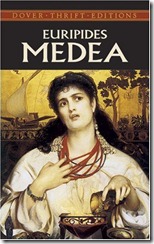
MedeaMedea by Euripides (translated by Rex Warner)

Publisher: Dover Thrift

Category: Classic

Challenges: Classic Circuit Ancient Greeks

Synopsis: (sorry this synopsis contains spoilers) Medea is abandoned by her husband Jason when he is offered marriage with a princess. Medea seeks her revenge on Jason by murdering both the princess and her father, the king, and finally her two children with Jason.

My Thoughts: “Hell hath no fury like a woman scorned” ~ William Congreve (paraphrased)

Whenever I read the Greek tragedies I can’t help but think of the daytime soap operas of our time. Although I can understand Medea’s feelings, she goes so totally overboard. Yes Jason’s behaviour is deplorable but to go on a killing spree is a bit much. At the same time, especially in the light of some of my other resent readings, I can’t help but see the vulnerable position Medea is put in. Although she is, by ancient Greek standards a great catch, being related to the Gods, she is pushed aside when Jason gets a “better offer” from the king. Medea herself points out this vulnerable position at several points in the play:

We women are the most unfortunate creatures.

Firstly, with an excess of wealth it is required

For us to buy a husband and take for our bodies

A master; for not to take one is even worse.

And now the question is serious whether we take

A good or bad one; for there is no easy escape

For a woman, nor can she say no to her marriage.

Not only is she put in a vulnerable position when she doesn’t have a husband any longer, the king is forcing her into an uncertain exile. To a certain extent Medea has made this bed for herself by her actions with regards to her own family. She committed crimes in order to help Jason (she killed her brother) that means she is already in exile, however, she committed these crimes to help her husband, who has now summarily cast her aside. Who wouldn’t have a little nutty? Despite this I still think her actions are totally overboard.

As I said initially, Greek tragedies never fail to remind me of soap operas. They are so melodramatic. But at the same time I think this is what makes them so enduring. The themes of abandonment and the following anger and wish for revenge are ones that we can relate to still. To some extent Medea’s story, when one disregards certain magical elements, could still take place today. And unfortunately it occasionally does. Part of me is saddened by this. Have we really not gotten any further along in our emotional lives? But at the same time I take a certain comfort in the fact that we haven’t devolved either. Is that bad? 

I thought Warner’s translation was really good. It was easy to follow the language and the story while still keeping some of the flow that Greek dramas should have. The publishers had also not gone overboard with the footnotes but rather kept these short but informative. What I would have liked was a short explanation of the preceding stories of Jason and Medea as it has been a very ancientgreeks-buttonlong time since I read/saw them. Yes I can go out and find them for myself, but it would have been handy to have them included in this edition. Overall I recommend this play and this edition to anyone who finds the Ancient Greeks intimidating as it is very short and very readable.

Signature

Copyright ©2011 Zee from Notes from the North. This post was originally posted by Zee from Notes from the North. It should not be reproduced without express written permission.